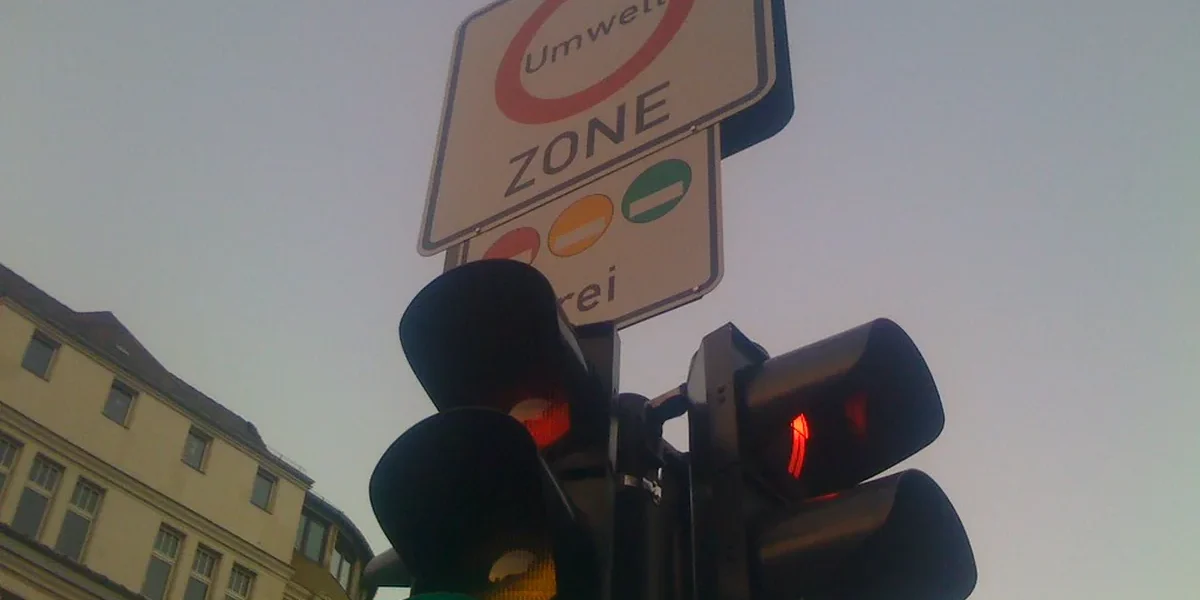
An Umweltzone (low-emission zone) is a signed urban access area in Germany. Cars, trucks, and buses need a green Umweltplakette (emissions sticker) on the windshield to drive there legally. The system has operated since 2008 and applies equally to German and foreign-registered vehicles.
The reason is measurable. German cities repeatedly exceeded European limit values for Feinstaub (particulate matter, PM10) and Stickstoffdioxid (nitrogen dioxide, NO2) in busy inner-city areas. The zones aim to lower those readings and improve Luftqualität (air quality) where people live and work.
A green sticker costs roughly €5 to €15, is valid in every low-emission zone across Deutschland for the life of the vehicle, and driving into a marked zone without one is an administrative offense currently penalized with a €100 fine.
That one sticker covers Berlin, Munich, Frankfurt am Main, Stuttgart, Cologne, and roughly 50 to 60 other zones nationwide. A handful of cities add diesel restrictions, too. That’s where drivers often get caught out.
Key Takeaways
- A green emissions sticker is valid in every German low-emission zone and is required for German and foreign vehicles alike.
- Eligibility depends on the emissions code in your vehicle papers, not on the car’s age or country of registration.
- Some cities, notably Munich, add separate diesel rules that a green sticker alone does not satisfy.
How Germany’s Low-Emission Access Rules Work
Germany’s low-emission access rules use a national sticker system for locally defined zones. The federal government defines four Schadstoffgruppen (pollutant groups), while individual cities decide where the Umweltzonen begin and end. Since 2012, only vehicles with a green sticker may enter the existing zones, and a sticker issued anywhere in the country works in all of them.
Why Were Low-Emission Zones Introduced?
Inner-city monitoring stations in Deutschland regularly exceeded EU limit values for PM10 and NO2 during the 2000s. Commercial vehicle traffic added significantly to particulate pollution in dense urban areas.
Cities responded with a Luftreinhalteplan (air quality plan), the local document that lists the measures a municipality will use to bring readings back under the limits. A Verkehrsverbot or Zufahrtsbeschränkung (traffic ban or access restriction) for older vehicles became a standard tool, phased in from 2008 onward. The Umweltbundesamt (Federal Environment Agency) publishes the national overview of existing zones.
What Law Governs Vehicle Access?
The legal basis is the 35. BImSchV, the 35th ordinance implementing the Bundes-Immissionsschutzgesetz (Federal Immission Control Act). People also know it as the labeling or environmental sticker ordinance.
The ordinance assigns each affected vehicle to one of four Schadstoffgruppen. The decisive factor is the Emissionsschlüssel (emissions code) recorded in the vehicle papers. It also lists the vehicle categories that the rules exclude entirely.
How Are Zone Boundaries Marked?
Zone limits use a Verkehrszeichen (traffic sign) reading “Umweltzone,” placed at every entry point. Directly below it, a Zusatzzeichen (supplementary sign) shows which sticker colors are permitted, normally a green sticker next to the word frei (free to enter).
An identical sign with the word Ende marks the exit. The Fahrverbot applies only inside the signed area, so an Autobahn routed past a city usually stays outside it. Anyone mapping a driving route can combine this check with wider planning a trip to Germany preparation.
Which Vehicles Qualify for the Green Sticker?
Petrol cars meeting Euro 4 or better and diesel vehicles meeting Euro 4 or better qualify for the grüne Plakette (green sticker), which corresponds to Schadstoffgruppe 4. Most petrol cars with a regulated Katalysator (catalytic converter) built from the early 1990s onward also reach green status. Older diesels usually need a retrofitted Partikelfilter (particulate filter) to move up a group.
How Do Emission Classes Map to Sticker Colors?
The Feinstaubplakette comes in three colors. Schadstoffgruppe 1 receives no sticker at all.
| Pollutant group | Sticker | Diesel standard | Petrol standard |
|---|---|---|---|
| Schadstoffgruppe 1 | None | Euro 0 / Euro 1 | Euro 0 without catalytic converter |
| Schadstoffgruppe 2 | Red | Euro 2 (or Euro 1 with filter) | – |
| Schadstoffgruppe 3 | Yellow | Euro 3 (or Euro 2 with filter) | – |
| Schadstoffgruppe 4 | Green | Euro 4, 5, 6 (or Euro 3 with filter) | Euro 1 with catalytic converter and newer |
Red and yellow stickers no longer grant access to the current zones. Elektrofahrzeuge (electric vehicles) with an E-Kennzeichen (E-plate) qualify for the green sticker as zero-emission vehicles. The federal government has also been preparing a dedicated exemption rule for them.
Where Can You Find the Emissions Code in Your Papers?
German vehicles carry the Emissionsschlüsselnummer in the Zulassungsbescheinigung Teil I (registration certificate part I), the document previously called the Fahrzeugschein. Look at field 14.1, or at position 1 on the older paper format.
Foreign registration documents show the Abgasnorm or Euronorm differently. Many issuers therefore accept the stated Emissionsklasse or the date of first registration as evidence. Bring the original Fahrzeugpapiere, since issuers frequently reject copies.
Can Retrofitting Change a Diesel Vehicle’s Classification?
Yes. Fitting an approved Partikelfilter to a diesel vehicle moves it up one Schadstoffgruppe. A Euro 3 diesel with a certified filter can therefore reach green status.
The upgrade counts only after a registration office or authorized testing organization enters it into the vehicle papers. Without that entry, the vehicle keeps its original classification, regardless of the hardware installed.
How Do You Get and Display an Emissions Sticker?
Vehicle registration offices, technical inspection organizations, and many repair garages sell emissions stickers. They cost around €5 to €15, depending on the issuer. The sticker stays tied to the license plate, has no expiry date, and must sit on the inside of the windshield.
Where Can You Buy an Umweltplakette?
- Zulassungsbehörden (vehicle registration offices) in any German city
- Inspection stations run by TÜV, DEKRA, GTU, and KÜS
- Authorized repair garages and workshops
- ADAC service points and some outlets near border crossings
- Accredited online issuers, which mail the sticker to a home address abroad
Overseas drivers should order well before departure. Online issuers need time for international post, and arriving without a sticker means finding an inspection station before entering the city.
What Documents Do You Need?
Only one document is required: the vehicle registration certificate. For German vehicles, that is the Zulassungsbescheinigung Teil I. For ausländische Autos (foreign cars), it is the equivalent national registration document showing the emissions class or first registration date.
The rules cover Pkw (passenger cars), Lkw (trucks), Nutzfahrzeuge (commercial vehicles), and Busse (buses). Campers and motorhomes registered as passenger cars follow the same requirement.
Where Does the Sticker Go on the Windshield?
Place the sticker on the inside of the Windschutzscheibe, on the passenger side at the bottom, where people can see it clearly from outside. Write the full license plate number on it before fixing it in place.
The material tears if removed, so you can’t transfer a sticker between vehicles. Selling the car means the new owner must buy a fresh one.
Where Do Drivers Need to Check Local Restrictions?
Drivers should check the municipal website for every city on their route. Zone boundaries and extra diesel rules are set locally rather than nationally. Berlin operates one of the largest zones inside the S-Bahn ring, while Munich applies diesel restrictions inside and along the Mittlerer Ring that go beyond the green-sticker requirement.
How Does the Umweltzone Berlin Affect Visitors?
The Umweltzone Berlin covers the area inside the S-Bahn ring, including Mitte, large parts of Kreuzberg, and much of Charlottenburg. A green sticker is required, and the zone includes most addresses visitors want to reach.
Anyone staying near the Brandenburg Gate or heading toward Checkpoint Charlie is inside the boundary. Parking outside the ring and using public transport removes the issue entirely. The Deutschlandticket covers local trains and buses across the country, and the Berlin regional guide offers wider context on the capital.
What Makes Munich’s Diesel Rules Different?
Munich combines the standard green-sticker zone with a separate diesel restriction along and inside the Mittlerer Ring, the city’s inner ring road. Older diesel vehicles below the applicable Euro threshold face a driving ban there, even when they carry a valid green sticker.
The thresholds and exemption categories have changed several times, so confirm the current rule with the City of Munich before driving in. Visitors heading to Theresienwiese for Oktoberfest are within the affected area, and the U-Bahn reaches the grounds directly.
Which Other Major Cities Commonly Affect Travel Plans?
- Stuttgart: a zone covering the whole city area, plus historically strict diesel rules; see the Stuttgart city guide for surrounding destinations
- Frankfurt am Main: zone covering the inner city inside the ring roads
- Bremen, Hannover, Leipzig, Mainz: established zones covering central districts
- Aachen: zone rules have differed from the standard pattern, so verify locally
Cologne, Düsseldorf, and Nuremberg also operate zones. Route planning across the 16 federal states is easier when the sticker is already on the windshield, since it works everywhere.
Who Is Exempt and What Happens if You Enter Without Approval?
Annex 3 of the 35. BImSchV exempts several vehicle categories outright. Individual Ausnahmegenehmigungen (exemption permits) can also be granted when the local registration office approves an application.
Driving into a zone without a valid sticker or permit is an Ordnungswidrigkeit (administrative offense), currently penalized with a €100 Bußgeld (fine).
Which Vehicle Types Are Generally Exempt?
- Motorräder (motorcycles) and three-wheeled motor vehicles
- Work machines, agricultural and forestry tractors, mobile machinery
- Oldtimer (classic cars) with a German H-Kennzeichen, issued to vehicles at least 30 years old in largely original condition
- Vehicles for Schwerbehinderte (people with severe disabilities) holding the relevant marker
- Vehicles operating under special rights, including Polizei (police) and emergency services
Elektrofahrzeuge receive the green sticker under the current rules. A federal exemption arrangement specifically for e-vehicles has been in preparation.
When Can You Apply for an Individual Exception?
Applications go to the Zulassungsbehörde or the municipal authority responsible for the zone in question. Officials assess permits case by case. They commonly consider requests from Anwohner (residents), Lieferverkehr (delivery traffic), Taxen (taxis), and businesses that can show economic hardship.
Processing takes time, and fees apply. Apply weeks before travel, since officials won’t grant an exemption retroactively after a Verkehrsverbot has been breached.
What Penalties Can Apply for Noncompliance?
The standard penalty for entering a zone without a valid sticker is €100. The same amount applies when a vehicle displays a sticker color the zone does not permit.
Local diesel bans carry their own penalty schedules, which differ from the national sticker fine. The responsible municipality sets the enforcement amounts, so confirm the current figure with the city and the Umweltbundesamt before travel.
Frequently Asked Questions
What does Umweltzone mean in Germany?
An u003cemu003eUmweltzoneu003c/emu003e is a low-emission zone, a signed area of a German city where only vehicles meeting a set emissions standard may drive. Zones have operated since 2008 and are marked by an entry sign showing which sticker colors are permitted.
Do foreign cars need an Umweltplakette in Germany?
Yes. u003cemu003eAusländische Autosu003c/emu003e follow exactly the same rules as German-registered vehicles and must display a valid u003cemu003eUmweltplaketteu003c/emu003e to enter a zone. You can order the sticker online in advance using the foreign registration document.
Where can I buy a green Umweltplakette?
Green stickers are sold at vehicle registration offices, TÜV, DEKRA, GTU and KÜS inspection stations, many repair garages, ADAC service points, and accredited online issuers. Prices run about €5 to €15, and the only document needed is the vehicle registration certificate.
Can I drive into Berlin without an emissions sticker?
No. The u003cemu003eUmweltzone Berlinu003c/emu003e inside the S-Bahn ring requires a green sticker, and entering without one is an administrative offense fined at €100. Parking outside the ring and switching to the S-Bahn or U-Bahn is a practical alternative.
Does a green sticker allow every diesel vehicle into Munich?
No. München applies separate diesel restrictions inside and along the u003cemu003eMittlerer Ringu003c/emu003e. These rules affect older u003cemu003eDiesel-Fahrzeugeu003c/emu003e, even when they carry a green sticker. Before driving in, check the current Euro threshold and exemption list with the City of Munich.